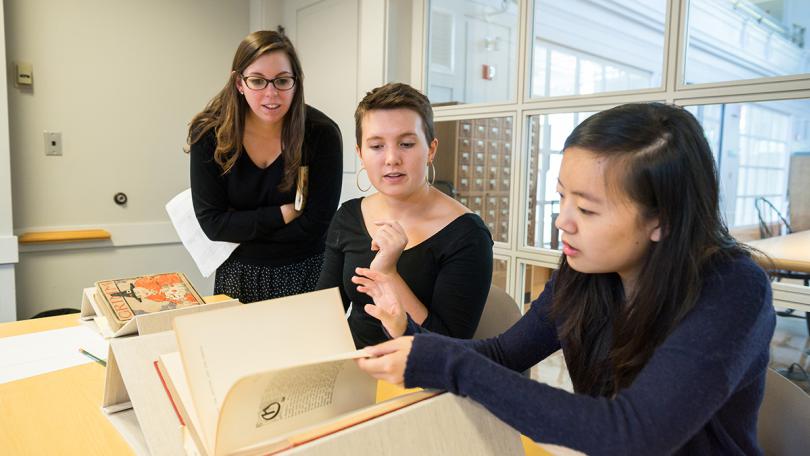
Stewarded by a team of specialists, Rauner Special Collections Library houses over 100,000 rare books, millions of manuscripts, and the extensive Dartmouth College Archives. The team collaborates and partners with students, faculty, staff, and the archive-curious at Dartmouth—and across the globe—to accelerate research and advance scholarship. Come and get hands on with us!
Search Our Collections

Search Our Collections

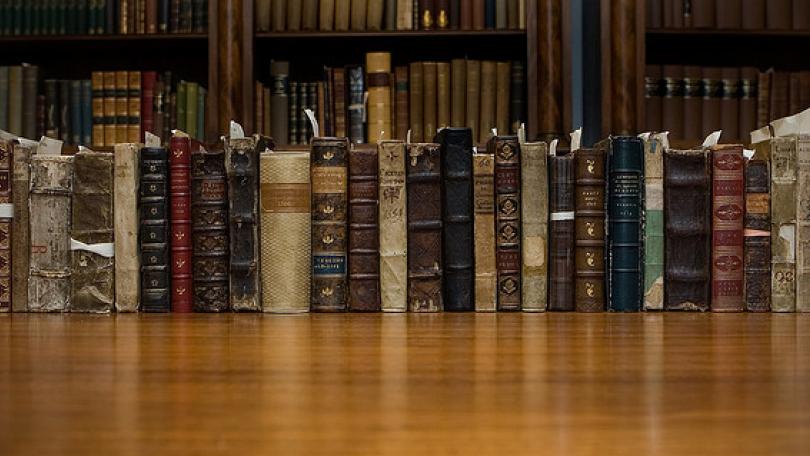
Special rare books in Rauner Library

Not Sure Where to Begin?

Send us your questions by email!

Cool at Rauner

Rauner Blog Feed
Leaf from Caxton's Canterbury Tales
Way back in 1476, William Caxton returned to England from the continent with some fancy new tech to show off. While in Flanders he learned the relatively young art of printing. After a few years practicing the trade there, he packed up his press and headed home to see if there was an appetite for the printed word in England. There was.

Over the next 15 years, Caxton produced the earliest printed works in England. His taste was decidedly English. His first publication was Chaucer's Canterbury Tales, but he followed with other major works of English history and literature.

Winnie-the-Pooh was first published on October 14, 1926 as the second of four wildly successful children’s books by Alan Alexander (A. A.) Milne (When We Were Very Young, Winnie-the-Pooh, Now We Are Six, and The House at Pooh Corner). One hundred years later, these stories and characters are as beloved as ever, and Milne is remembered mainly as a children’s author. But Milne’s writing career began well before he introduced the world to Pooh, Piglet, and their friends.
Illustration showing Brahe's cosmology
After Copernicus laid out his fancy new theory placing the Sun at the center of the universe, and then Galileo argued so forcefully for it, you would think that any self-respecting astronomer would acquiesce and admit the Earth no longer held primacy in the universe. But Tycho Brahe was a stubborn cuss, and a stickler for good observation. He figured with the more accurate observations he could make with his state-of-the-art observatory, he could prove Copernicus and Galileo to be fools for doubting the long-held dogma that the Earth was the center of everything.

Exhibits

Small bear (Winnie) to left of sign that reads 'In Which Pooh Turns One Hundred'. To right is a small boy (Christopher Robin) and other animal characters from the book (Roo, Kanga, Piglet, etc).
Now on Exhibit
September 14, 2026 - December 04, 2026
Baker 2 West, Rauner Library, Class of 1965 Galleries
Rauner Staff Picks. Shows comic book like labels for Books!, Manuscripts!, Photos!, Scrolls!, Paintings!, Postcards!, and Much Much More! Multiple colors on a blue background.
July 02, 2026 - September 04, 2026
Rauner Library, Class of 1965 Galleries
Triptych like image. Left hand illustration  depicts older man with book in lap and quill pen in hand. Middle depicts Black man reclining in field with book. Right hand depicts woman in chains.
April 06, 2026 - June 19, 2026
Rauner Library, Class of 1965 Galleries